

Commercial Trucking Insurance Rates in Ohio, Texas, Pennsylvania and Illinois: What Really Drives Long-Haul Trucking Premiums?
Primary Search Topics: commercial truck insurance Ohio, trucking insurance Texas, Pennsylvania truck insurance, Illinois truck insurance, Class 8 truck insurance, long-haul trucking insurance, Progressive trucking insurance, GEICO commercial truck insurance, CDL driver insurance factors
September 5, 2026
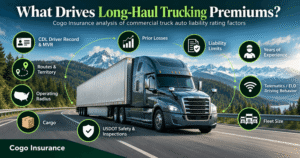
Trucking companies often ask Cogo Insurance a deceptively simple question:
Why can two trucking companies with similar tractors and similar operations receive dramatically different trucking insurance rates?
For a Class 8 interstate motor carrier, the answer goes far beyond the value of the truck or the company’s loss history. The individual CDL driver, operating radius, cargo, garaging location, routes, USDOT safety information, years in business, coverage limits and increasingly actual driving behavior can all affect what an insurer is willing to charge.
Cogo Insurance reviewed public carrier information and rate and rule filing sources for Progressive and GEICO, concentrating on four states: Ohio, Texas, Pennsylvania and Illinois.
Our primary target was not delivery vans, contractors or ordinary business auto. It was:
Class 8 semi tractors, for-hire interstate trucking, long-haul operations with a radius greater than 500 miles.
Progressive itself describes its super-regional long-haul segment as policies containing at least one semi truck tractor with a radius of more than 500 miles. The distance is measured as a straight line between two points rather than road mileage.
That makes this analysis much closer to the insurance problem faced by owner-operators and small motor carriers running dry vans, reefers, flatbeds and similar interstate operations.
Which Insurance Companies Did We Analyze?
For the carrier and filing research, Cogo Insurance used the following underwriting entities:
| State | Progressive | GEICO |
|---|---|---|
| Ohio | Progressive Commercial Casualty Company and Artisan & Truckers Casualty Company | GEICO Marine Insurance Company |
| Texas | Progressive County Mutual Insurance Company and Artisan & Truckers Casualty Company | GEICO County Mutual Insurance Company |
| Pennsylvania | Progressive Commercial Casualty Company | GEICO commercial auto and truck disclosures used for comparison |
| Illinois | Progressive Commercial Casualty Company | GEICO commercial auto and truck disclosures used for comparison |
Pennsylvania and Illinois are particularly useful when examining Progressive because public filings in those states can sometimes provide context for rules or methodologies that are not visible in Texas.
SERFF, the System for Electronic Rates and Forms Filing, provides public access to filings that regulators have made available. Texas expressly warns that documents marked confidential can be omitted from the public filing. Pennsylvania makes approved rate and form filings publicly searchable, subject to redaction of protected information. Illinois provides public SERFF access as well.
That produces an unavoidable limitation. A carrier may publicly disclose that it uses a variable while keeping the exact mathematical relativity, model coefficient or interaction with other variables confidential.
Cogo Insurance therefore separates the evidence into three categories:
- Confirmed pricing factor: The carrier publicly says the variable affects price.
- Confirmed data or underwriting variable: The carrier asks for or uses the information, but the public evidence does not show a separate mathematical premium factor.
- Not established: We found no reliable evidence that the variable independently changes premium.
That distinction matters when discussing individual CDL drivers.
The Biggest Drivers of Long-Haul Trucking Insurance Rates
For a Class 8 OTR motor carrier, Cogo Insurance would rank the major variables approximately as follows. The ranking describes potential influence, not a guaranteed carrier formula.
| Rating or underwriting variable | Likely importance for Class 8 OTR | Progressive evidence | GEICO evidence |
|---|---|---|---|
| Driver MVR, accidents and violations | Very high | Confirmed | Confirmed |
| Operating radius and long-haul exposure | Very high | Confirmed | Confirmed |
| Territory, garaging and operating geography | Very high | Confirmed | Confirmed |
| Cargo and trucking operation | Very high | Confirmed | Confirmed |
| Liability limits and coverage selections | Very high | Confirmed | Confirmed |
| USDOT and inspection history | High to very high | Confirmed | Confirmed |
| Years in business and operating history | High | Part of broader underwriting | Confirmed |
| Claims and prior loss history | High | Confirmed | Confirmed |
| CDL experience | High potential significance | Explicitly collected | Ohio CDL discount confirmed, exact tenure formula not public |
| Driver age | Potentially high for some drivers | Standalone current factor not established publicly | Confirmed truck pricing variable |
| Telematics and ELD driving behavior | High where used | Smart Haul | DriveEasy Pro |
| Truck type, age, condition and value | High | Confirmed | Confirmed |
| Fleet size and number of drivers | Medium to high | Exposure dependent | Confirmed |
| Continuous prior insurance | Medium | Discount confirmed | Carrier dependent |
| Driver marital status | Usually secondary to core trucking factors | Current use not established publicly | Confirmed truck pricing variable |
| CDL endorsements by themselves | Usually low or no direct effect | No standalone factor found | No standalone factor found |
| Payment method | Low to medium | Pay-in-full savings | Pay-in-full savings |
There is no single percentage that applies to every trucking company. A clean driver cannot erase the added exposure of long-haul operations, and an excellent motor carrier safety record cannot necessarily offset a driver with serious recent violations.
The final price results from the combination.
1. The CDL Driver’s MVR Is One of the Strongest Factors
This is the least ambiguous part of the research.
Progressive states that it reviews motor vehicle reports for drivers who have access to commercial vehicles. On its Ohio, Texas, Pennsylvania and Illinois commercial auto pages, Progressive says accidents and violations usually increase the rate and that the insurer generally considers the preceding three years of driving history.
Progressive goes even further in its commercial quote requirements. It asks for the month and year of accidents and traffic violations, including speeding tickets, during the previous three years.
GEICO likewise identifies driving record as a commercial truck pricing factor. Its current trucking materials say that accidents can affect cost and encourage truck drivers to maintain clean driving histories.
For Cogo Insurance clients, this means an MVR should never be viewed as merely an eligibility document. It can materially affect price.
A driver with:
- no accidents,
- no speeding violations,
- no reckless driving,
- no license suspensions,
- no serious CDL violations,
is a very different insurance risk from a driver with several recent events.
Recency matters as well. A violation that is about to age outside an insurer’s experience period may produce a different result than the same violation from six months ago.
Does a minor speeding ticket matter?
It can.
Progressive expressly says driving violations can increase commercial auto rates, and its quote process asks for speeding violations specifically.
For trucking companies shopping insurance through Cogo Insurance, the practical lesson is simple: provide complete MVR information before binding. A quote based on an assumed clean record can change after the insurer orders the actual MVR.
2. Driver Age Can Affect Truck Insurance, but Progressive and GEICO Do Not Disclose It the Same Way
This was one of the questions that prompted our research.
GEICO explicitly identifies driver age as one of its commercial truck insurance cost factors. Its commercial truck page says truck pricing can consider normal automobile variables such as:
- driver age,
- driving history,
- marital status,
along with trucking variables such as USDOT compliance, cargo, truck type, coverage and inspection history.
This is much stronger evidence than simply observing that an application requests a date of birth.
What GEICO does not publicly provide is a current Class 8 truck table showing something such as:
- age 21 to 24: factor X,
- age 25 to 29: factor Y,
- age 30 to 64: factor Z.
Cogo Insurance found no reliable public GEICO trucking table for Ohio or Texas that would justify assigning those percentages.
For Progressive, we found clear public evidence regarding CDL status, CDL tenure and driving history, but not a current public statement establishing a standalone driver age relativity for Class 8 trucking in these four states.
That does not mean Progressive ignores age. It means the public evidence does not support stating that Progressive currently applies a separate age multiplier to these trucking policies.
This distinction matters.
GEICO: driver age is confirmed as a commercial truck pricing variable.
Progressive: a separate current Class 8 driver age factor is not established from the public material reviewed.
3. How Long the Driver Has Held a CDL Matters to Progressive’s Risk Assessment
Progressive’s commercial insurance quote checklist asks two distinct CDL questions:
- Does the driver have a CDL?
- How long has the driver had the CDL?
Progressive states that it uses driver information and state motor vehicle records to determine risk factors.
That is meaningful.
A driver who received a CDL six months ago and a driver who has held a CDL for 15 years are not represented identically in Progressive’s data collection.
What remains unavailable publicly is the precise Progressive formula.
Cogo Insurance did not find a reliable current filing table stating:
less than 1 year CDL = factor X
1 to 2 years = factor Y
3 to 5 years = factor Z
more than 5 years = factor A
Nor should a broker confuse years holding a CDL with years driving a Class 8 tractor.
A person might have held a CDL for ten years but only recently begun operating a tractor-trailer. Another driver might have six years of Class 8 experience, all of it long-haul.
Those are different facts.
For a trucking submission, Cogo Insurance recommends separating:
- CDL original issue date,
- years holding CDL-A,
- years driving Class 8 equipment,
- years of interstate OTR experience,
- years with the current employer or motor carrier.
The public Progressive evidence directly establishes the importance of CDL tenure as collected information. It does not prove that each of the four experience measures receives a separate filed multiplier.
4. GEICO Has an Ohio CDL Experience Discount, but the Name Can Be Misleading
GEICO’s Ohio commercial auto page contains a particularly interesting discount:
CDL Experience Discount
GEICO says eligibility is based on the number of drivers with a Commercial Driver’s License.
That wording deserves attention.
The name sounds like a discount based on the number of years a driver has held a CDL. GEICO’s public Ohio description instead refers to the number of CDL drivers.
Cogo Insurance would therefore not tell a trucking customer that:
“Five years with a CDL gets you a GEICO discount.”
The public source does not say that.
What we can say is:
GEICO Ohio expressly recognizes CDL characteristics through a commercial auto discount mechanism.
The equivalent CDL discount is not publicly listed on the current GEICO Texas, Pennsylvania or Illinois state pages we reviewed.
That could reflect a genuine state difference, differences in disclosure, or differences in the applicable rating plans. It should not be assumed that the Ohio treatment automatically applies elsewhere.
5. Does Marital Status Affect Commercial Truck Insurance?
With GEICO, apparently yes.
GEICO’s commercial truck insurance page explicitly identifies marital status as one of the ordinary automobile variables that can influence truck insurance cost.
This is somewhat surprising because many trucking professionals associate marital status with personal auto insurance rather than Class 8 trucking.
Cogo Insurance found no comparable current Progressive disclosure establishing marital status as a standalone Class 8 OTR rating variable in Ohio, Texas, Pennsylvania or Illinois.
There is another issue of magnitude.
Even where marital status is used, Cogo Insurance would expect factors such as MVR, accidents, long-haul mileage, cargo, limits, territory and safety history to have more practical influence on a Class 8 trucking premium than marital status alone.
GEICO confirms the variable. It does not publicly disclose its commercial truck coefficient or how it interacts with the rest of the model.
6. Do CDL Endorsements Lower or Increase Truck Insurance?
This question produces a different result.
FMCSA recognizes endorsements including:
- T: double and triple trailers
- N: tank vehicle
- H: hazardous materials
- X: tank vehicle plus hazardous materials
along with passenger and school bus endorsements.
Cogo Insurance did not find reliable evidence that Progressive or GEICO gives a driver an automatic standalone credit simply for possessing H, N, X or T.
Nor did we find evidence of an automatic surcharge merely for having one of those endorsements.
Instead, the effect is usually connected to what the trucking company actually does.
Consider two CDL-A drivers who both possess an X endorsement.
Driver 1 hauls ordinary dry freight.
Driver 2 operates a tanker carrying hazardous material.
The second operation presents a very different insurance exposure. The difference comes from the actual cargo, equipment, operation, limits and regulatory requirements, not simply from the X printed on the license.
Federal financial responsibility requirements illustrate the difference. FMCSA generally requires at least $750,000 of public liability coverage for interstate for-hire property carriers operating vehicles of 10,001 pounds or more. Certain hazardous materials require $1 million, while specified higher-hazard materials require $5 million.
For this reason, Cogo Insurance recommends recording CDL endorsements but not treating them as simple credits or debits.
The credential matters most when it identifies the type of operation the driver is actually performing.
7. CDL Restrictions Can Matter Even Without a Published Rate Factor
FMCSA recognizes CDL restrictions that can limit the equipment a driver may operate. Examples include restrictions involving full air brakes and manual transmissions.
Cogo Insurance did not find a public Progressive or GEICO table assigning a standalone premium multiplier to each CDL restriction.
Yet restrictions can still matter in underwriting.
If a driver is not properly licensed for the equipment assigned to that driver, the issue may become eligibility rather than price.
This is a recurring theme in truck insurance:
Not every underwriting fact appears as a 1.05 or 1.20 rate factor. Some facts determine whether the insurer wants the risk at all.
8. Operating Radius Is One of the Largest Structural Cost Drivers
For the type of risk examined here, radius is not a small variable.
Progressive specifically identifies a long-haul or super-regional class for policies with at least one semi tractor and a radius greater than 500 miles.
Across Ohio, Texas, Pennsylvania and Illinois, Progressive’s state materials consistently identify travel radius as a pricing factor.
GEICO says the same thing. Its current truck cost guidance says long-haul routes generally produce higher insurance costs than local or regional operations.
Why?
A long-haul Class 8 tractor creates more exposure through:
- more miles,
- more time on the road,
- more states and legal jurisdictions,
- more congested metropolitan areas,
- more nighttime driving,
- unfamiliar routes,
- weather variation,
- greater fatigue exposure.
For Cogo Insurance clients, changing from a 300-mile regional operation to unrestricted interstate OTR can therefore change far more than one answer on the application.
It changes the insurer’s view of the entire operation.
9. Territory Is More Than the State Where the Truck Is Garaged
Progressive’s state-specific materials repeatedly identify location as a pricing factor.
In Texas, Progressive uses the example that commercial coverage can cost more in Dallas than in Beaumont. In Ohio, it compares larger cities with smaller communities. Pennsylvania and Illinois make similar distinctions.
GEICO’s Texas page similarly says businesses operating in higher-traffic areas such as Houston, Dallas or Austin can face increased rates.
For OTR trucking, Cogo Insurance would look beyond the motor carrier’s mailing address.
Two Ohio-based motor carriers could both have a Dayton garaging address while operating very different lanes:
Carrier A: Ohio, Indiana, Kentucky, Tennessee.
Carrier B: frequent New York City, northern New Jersey, Chicago and major East Coast corridors.
The second carrier has a different geographic exposure even though both trucks are registered in Ohio.
Modern telematics makes this distinction increasingly measurable.
10. Telematics Is Becoming a Real Rating Variable, Not Just a Safety Program
This may represent the biggest change in commercial trucking insurance pricing.
Progressive Smart Haul
Progressive’s Smart Haul program connects to the ELD data of eligible for-hire truckers.
Progressive says customers using preferred ELD vendors can receive at least a 5 percent enrollment discount, while some with established safety records can save 15 percent or more. Progressive then uses more recent driving data to adjust the rate at renewal, and the renewal premium can move either up or down.
This means that actual driving data can now influence price rather than simply historical accidents and citations.
For a Class 8 OTR motor carrier, the difference is substantial.
An MVR tells the insurer what was officially recorded.
An ELD or telematics feed tells the insurer how the vehicle is actually being operated.
GEICO DriveEasy Pro
GEICO goes further in publicly identifying the behavioral variables.
Its DriveEasy Pro commercial program can use an existing ELD for trucking operations. GEICO says the safe-driving result can generate an additional renewal saving of up to 10 percent or a surcharge of up to 10 percent.
GEICO identifies the following components of its commercial driving score:
- hard braking,
- fast acceleration,
- sharp turns,
- distance driven,
- consistency of speed,
- late-night driving,
- total time driven,
- route consistency.
GEICO defines late-night driving as driving between 10 PM and 5 AM.
This is highly relevant to long-haul trucking.
Consider two CDL drivers with:
- the same age,
- the same years of CDL experience,
- identical clean MVRs,
- no prior accidents.
One drives primarily during daylight hours on consistent lanes and exhibits smooth braking and acceleration.
The other spends a large share of driving time overnight, changes routes frequently and generates repeated harsh-driving events.
Traditional underwriting might have treated them similarly.
Telematics gives the insurer a way to differentiate them.
GEICO’s connected trucking initiative with Daimler Truck Financial Services reinforces this direction. The program uses truck telematics data from Freightliner and Western Star vehicles to support risk assessment and safe-driving incentives.
For Cogo Insurance, telematics is therefore becoming part of insurance placement strategy rather than merely fleet management.
11. USDOT Compliance and Inspection History Matter
Both Progressive and GEICO expressly identify motor carrier safety information.
Progressive lists inspection history among its commercial truck cost factors.
GEICO lists both USDOT compliance and inspection history.
This means insurers are not limited to traditional loss runs.
The motor carrier’s regulatory and safety history can tell an insurer something about how the operation is managed before an insured loss ever occurs.
Cogo Insurance therefore reviews information such as:
- USDOT status,
- inspections,
- out-of-service events,
- safety violations,
- crash history,
- vehicle maintenance indicators,
- driver-related compliance issues.
A BASIC score or FMCSA measurement should not automatically be translated into a specific premium surcharge unless the carrier’s filed methodology supports it. The broader safety history, however, is plainly relevant to truck underwriting.
12. Cargo Can Change the Risk Dramatically
Progressive identifies cargo as a commercial truck insurance pricing factor.
GEICO does the same and gives a straightforward example: transporting relatively low-risk goods presents a different exposure from transporting valuable electronics.
Cargo influences several dimensions of the account:
- liability severity,
- cargo theft exposure,
- cargo coverage limits,
- specialized equipment,
- loading and unloading hazards,
- regulatory requirements,
- catastrophic loss potential.
A dry-van general-freight operation therefore should not be expected to price like:
- auto hauling,
- tanker operations,
- hazmat,
- oversized equipment,
- refrigerated pharmaceuticals,
- high-value electronics.
This is why Cogo Insurance asks for the actual commodities hauled rather than accepting “general freight” as the end of the discussion.
13. Years in Business Can Matter Significantly
GEICO expressly identifies how long the company has been operating as a commercial trucking rate factor. Established operations with a proven record can receive different treatment from new businesses with little operating history.
This helps explain why a new motor carrier with:
- an excellent driver,
- a clean CDL,
- a new tractor,
- no losses,
can still receive a high premium.
The carrier has very little history on which to evaluate the business itself.
Insurers may be looking for evidence that management can:
- select drivers,
- maintain equipment,
- comply with FMCSA requirements,
- manage hours of service,
- control losses,
- operate consistently.
At Cogo Insurance, we would not assume that a clean owner-operator automatically receives the same pricing as an established motor carrier simply because both have clean MVRs.
14. Liability Limits Are a Direct Cost Driver
Higher limits increase the amount the insurer has at risk.
Progressive explicitly identifies coverage requirements as a truck insurance cost variable. Its state pages show that a $1 million combined single limit costs more than state-minimum commercial auto limits.
For interstate Class 8 trucking, state minimum automobile limits are often beside the point.
FMCSA requires at least $750,000 for many nonhazardous interstate for-hire property carriers over 10,001 pounds, with higher requirements for certain hazardous commodities.
In practice, many shippers, brokers and contracts require $1 million of auto liability, which is why $1 million CSL is so common in trucking.
A carrier buying $1 million, $2 million or higher protection therefore should not expect the same premium.
15. The Tractor Itself Matters
GEICO says truck type, age and condition can influence the rate and states that newer trucks with advanced safety features can receive more favorable treatment in some circumstances.
Progressive identifies vehicle type as a truck pricing factor and says vehicle size and use affect commercial auto rates.
For primary liability, the truck is only part of the exposure.
For physical damage, it becomes much more significant.
A tractor worth $175,000 creates a different physical damage exposure from an older tractor worth $45,000.
Deductibles matter as well. A higher collision or comprehensive deductible shifts more first-dollar loss cost to the insured and can reduce the physical damage premium.
16. Claims History Still Matters, Even When the Driver Is Clean
Loss history remains one of the most familiar insurance variables.
GEICO’s state materials identify claims history as a commercial auto pricing consideration, while Progressive’s broader commercial auto disclosures say claims and driving history can affect premium.
For trucking, underwriters often care about more than the number of claims.
They may look at:
- frequency,
- severity,
- fault,
- open versus closed claims,
- bodily injury involvement,
- litigation,
- cargo losses,
- physical damage losses,
- trends across several years.
A $3,000 backing claim and a six-figure bodily injury claim do not tell the same story.
17. Fleet Size and Number of Drivers Can Affect Pricing
GEICO’s Texas commercial auto page expressly identifies the number of vehicles and employees as a pricing consideration.
Fleet size increases total exposure, but per-unit pricing does not necessarily increase in a straight line.
A larger fleet can sometimes produce more credible loss information and more stable underwriting data. At the same time, adding inexperienced or poor-performing drivers can deteriorate the account.
For Cogo Insurance, the more useful question is not simply:
How many trucks do you have?
It is:
Which driver is assigned to which tractor, how experienced are those drivers, what does each MVR show and how stable is the driver roster?
18. Prior Insurance and Payment Method Can Matter Too
Progressive offers potential savings for businesses that maintained continuous commercial auto insurance during the previous 12 months. Progressive also advertises pay-in-full savings for eligible commercial auto customers.
GEICO says payment method can affect overall commercial truck insurance cost and that paying in full may reduce installment expense or qualify for savings where available.
These are unlikely to overcome a poor driver or high-risk operation, but they can still affect the final premium.
For Cogo Insurance customers comparing quotes that are reasonably close, payment terms and prior-insurance credits can become meaningful.
What Did the Four-State Comparison Show?
Ohio
Ohio produced one of the clearest driver-specific findings.
GEICO identifies the following commercial auto factors in Ohio:
- vehicle type, weight and travel distance,
- driving history,
- garaging ZIP code,
- annual mileage,
- coverage and limits,
- claims history,
- years in business.
GEICO Ohio also specifically lists its CDL Experience Discount, based on the number of CDL drivers.
Progressive Ohio states that it looks at the preceding three years of driving history and identifies location, travel radius, vehicle characteristics and coverage as pricing variables.
For a Class 8 OTR risk based in Cincinnati, Columbus, Cleveland, Dayton or another Ohio city, Cogo Insurance would therefore pay very close attention to the actual CDL drivers, radius, MVRs and operating lanes.
Texas
Texas has some of the clearest public descriptions of commercial auto factors, but portions of SERFF filings can be kept from public view when documents are designated confidential. TDI explains this directly in its public SERFF guidance.
Progressive Texas identifies:
- vehicle size and use,
- three-year driving history,
- accidents and violations,
- location,
- travel radius,
- coverage limits.
GEICO Texas identifies:
- industry,
- vehicle type and use,
- heavy-duty vehicle exposure,
- long-distance travel,
- driver records,
- accidents,
- speeding violations,
- coverage limits,
- number of vehicles and employees,
- location and operating area,
- claims history,
- deductibles.
A 2026 industry report on a GEICO County Mutual commercial automobile filing states that the Texas filing incorporated telematics factors into rating calculations. The filing was described as rate-neutral and associated with the introduction of heavy-vehicle roadside coverage. Since portions of Texas filing support can be confidential, Cogo Insurance treats this as corroborating evidence rather than a substitute for the complete carrier rate manual.
For long-haul Texas trucking based in Houston, Dallas, Fort Worth, San Antonio, Laredo, El Paso or other major freight markets, geography can become especially significant because both local congestion and interstate operating exposure are present.
Pennsylvania
Pennsylvania’s public SERFF system allows approved rate and form filings to be searched, subject to statutory redactions.
Progressive’s Pennsylvania disclosures repeat the same architecture seen in Ohio and Texas:
- vehicle size and use,
- three-year driver history,
- accidents and violations,
- location,
- radius,
- limits.
Progressive even uses Pittsburgh versus Erie as an example of geographic pricing differences and distinguishes local driving from broader regional exposure.
GEICO Pennsylvania identifies:
- type of work,
- vehicle,
- driving history,
- distance driven,
- coverage amounts.
What Pennsylvania did not provide publicly was a trustworthy Progressive trucking table revealing the exact driver age, marital-status or CDL-tenure coefficients that could be transplanted into Texas.
That is itself a useful finding. The broad factors are visible. The most proprietary driver relativities remain difficult to reconstruct.
Illinois
Illinois provides SERFF public access through the Department of Insurance.
Progressive Illinois again describes:
- industry,
- vehicle size and use,
- three years of driving history,
- accidents and violations,
- location,
- radius,
- limits.
It specifically contrasts larger metropolitan exposure such as Chicago with smaller Illinois locations.
GEICO Illinois publicly identifies:
- industry,
- vehicle type,
- driving record,
- coverage amount,
and confirms that heavy trucks and tractor-trailers fall within its commercial vehicle offerings.
As with Pennsylvania, the public material helps confirm the broad rating architecture but does not reveal a reliable Progressive driver-age or CDL-experience multiplier table.
So What About the Individual CDL Driver?
For a Class 8 long-haul risk, Cogo Insurance would organize driver information this way:
| Driver characteristic | What the research shows |
|---|---|
| MVR | Very significant, clearly used |
| Accidents | Significant |
| Speeding and other moving violations | Significant |
| Major violations | Can affect price or eligibility |
| CDL status | Progressive explicitly asks |
| Length of time holding CDL | Progressive explicitly asks |
| Years driving Class 8 | Sensible underwriting variable, separate public factor not established |
| Years of OTR experience | Sensible underwriting variable, separate public factor not established |
| Driver age | GEICO explicitly uses age in truck pricing; Progressive standalone treatment not established publicly |
| Marital status | GEICO explicitly lists it; Progressive current treatment not established publicly |
| CDL endorsements | No standalone Progressive or GEICO pricing factor found |
| CDL restrictions | Can affect eligibility or equipment assignment, standalone factor not found |
| Night driving | GEICO telematics factor |
| Hard braking | GEICO telematics factor |
| Fast acceleration | GEICO telematics factor |
| Sharp turning | GEICO telematics factor |
| Distance driven | GEICO telematics factor |
| Hours driven | GEICO telematics factor |
| Route consistency | GEICO telematics factor |
| ELD safety history | Progressive Smart Haul can affect premium |
| Years with current carrier | May matter in underwriting, separate public rating factor not established |
| Driver turnover | Operational risk indicator, standalone public factor not established |
This is a much more accurate way to think about CDL driver pricing than simply saying insurers look at “driving history.”
What Cogo Insurance Would Want Before Marketing a Long-Haul Trucking Account
A cleaner submission can reduce uncertainty and prevent an insurer from quoting on assumptions that later prove incorrect.
For a Class 8 OTR account, Cogo Insurance would generally want accurate information on:
- Every driver’s CDL and license state.
- Original CDL issue date or years holding the CDL.
- Actual years of Class 8 experience.
- Actual years of OTR experience.
- Current MVRs.
- Accident and violation dates.
- CDL endorsements and restrictions.
- Tractor VINs, model years and stated values.
- Trailer types.
- Exact commodities hauled.
- Longest radius and actual operating lanes.
- USDOT number and authority information.
- Inspection and safety history.
- Current and prior loss runs.
- Years in business.
- Prior insurance and policy declarations.
- Requested liability, physical damage and cargo limits.
- Deductibles.
- ELD provider and available telematics history.
- Fleet size and driver assignments.
The goal is not to send every insurer a stack of unrelated documents. The goal is to give an underwriter enough verified information to understand why the trucking account deserves the best available classification and price.
What Can a Trucking Company Actually Do to Lower Its Insurance Premium?
Some factors cannot be changed immediately. A motor carrier cannot turn a two-year-old company into a ten-year-old company overnight.
Other factors can be managed.
Cogo Insurance generally sees the strongest opportunities in:
- Hiring and retaining drivers with clean MVRs.
- Screening violations before assigning a driver.
- Building documented Class 8 and OTR experience.
- Reducing preventable crashes.
- Maintaining good roadside inspection results.
- Controlling vehicle maintenance issues.
- Using ELD and telematics data to demonstrate safe driving.
- Reducing harsh braking, hard acceleration and unsafe turning.
- Managing nighttime exposure where operations permit.
- Maintaining continuous insurance.
- Reviewing cargo classifications for accuracy.
- Giving the broker accurate operating radius and lane information.
- Selecting deductibles that fit the company’s ability to retain risk.
- Shopping the account before renewal rather than after the current policy expires.
- Keeping loss runs and driver schedules current.
One of the most expensive mistakes Cogo Insurance sees in trucking is treating insurance shopping as a price-only exercise.
The account presented to the insurance company determines what the underwriter sees.
Summary
For Class 8 interstate long-haul trucking in Ohio, Texas, Pennsylvania and Illinois, the CDL driver matters a great deal, but not every personal characteristic carries equal weight for trucking insurance rates.
The strongest publicly supported driver factors are driving record, accidents, violations and increasingly actual driving behavior.
Progressive explicitly asks whether a driver has a CDL and how long the driver has held it. Its state materials consistently say it considers roughly three years of driving history. Progressive Smart Haul can use ELD data to modify truck pricing.
GEICO goes further publicly by identifying driver age and marital status as commercial truck insurance cost factors. GEICO Ohio has a CDL Experience Discount, though its public description says the discount is based on the number of CDL drivers rather than publishing years-of-experience brackets.
We found no reliable evidence that simply possessing H, N, X or T CDL endorsements produces a standalone Progressive or GEICO credit or surcharge. The insurance effect comes mainly from the operation those endorsements allow, such as tanker, hazardous materials or doubles and triples.
For most Class 8 OTR trucking companies, Cogo Insurance would put the greatest attention on:
driver record, operating radius, territory and lanes, cargo, USDOT and inspection history, years in business, loss history, liability limits and telematics.
Age and CDL experience can matter, especially with GEICO, but a clean 45-year-old driver cannot make a high-risk operation inexpensive by himself.
Truck insurance pricing is cumulative. The carrier is pricing the driver, truck, motor carrier, cargo and operating environment together.
Cogo Insurance works with trucking companies to organize those factors before the account is presented to insurance markets so that underwriters receive an accurate picture of the risk.
Frequently Asked Questions
Does a CDL driver’s age affect commercial trucking insurance rates?
GEICO explicitly says driver age can affect commercial truck insurance cost. Cogo Insurance did not find a current public Progressive Class 8 trucking table showing an independent driver-age factor in Ohio, Texas, Pennsylvania or Illinois.
Does being married lower a truck driver’s insurance rates?
GEICO lists marital status among its commercial truck insurance cost factors. The exact GEICO commercial truck discount or relativity is not publicly disclosed. Cogo Insurance did not find equivalent current Progressive evidence establishing marital status as a standalone Class 8 trucking factor.
Does the number of years a driver has held a CDL matter?
Progressive explicitly asks whether a commercial driver has a CDL and how long the driver has held it. The exact Progressive CDL-experience factor table is not publicly disclosed.
Does GEICO give a CDL discount?
GEICO’s Ohio commercial auto program advertises a CDL Experience Discount. Its public description says eligibility is based on the number of drivers with CDLs. Cogo Insurance would not assume that the same discount or formula applies in every state.
Does a Hazmat endorsement automatically increase trucking insurance rates?
We found no evidence that simply holding an H or X endorsement automatically creates a Progressive or GEICO trucking surcharge. Actually hauling hazardous material can substantially change the risk, required limits and insurance price. FMCSA requires liability limits as high as $5 million for certain hazardous-material operations.
Does a tanker endorsement increase insurance?
The N endorsement itself has not been shown to produce a standalone surcharge in the public Progressive or GEICO sources reviewed by Cogo Insurance. Operating a tanker can change the vehicle, cargo and severity exposure and may therefore materially affect the quote.
How far back does Progressive look at a truck driver’s record?
Progressive’s commercial materials for Ohio, Texas, Pennsylvania and Illinois say insurers generally consider the preceding three years of driving history, and Progressive’s quote checklist asks about accidents and violations during the previous three years.
Does one speeding ticket raise commercial trucking insurance rates?
It can. Progressive specifically asks about speeding violations, and both Progressive and GEICO identify driver violations as pricing considerations. The amount depends on the violation, recency, other driver history and the insurer’s rating plan.
Is truck insurance more expensive for new ventures?
Often, yes. GEICO expressly identifies years in business as a commercial truck rate consideration and says established businesses with a proven operating history may receive lower rates than new companies with little history.
Does driving more than 500 miles from base affect insurance?
Yes. Progressive has a specific super-regional long-haul category involving semi truck tractors with a radius greater than 500 miles. Both Progressive and GEICO identify distance and operating radius as truck insurance pricing factors.
Can ELD data reduce trucking insurance rates?
Yes, depending on the insurer, program and eligibility. Progressive Smart Haul uses ELD information and says preferred-vendor participants receive at least a 5 percent initial discount, with some established safe operations receiving 15 percent or more. GEICO DriveEasy Pro can use ELD information and safe-driving scores, with the potential for renewal credits or surcharges.
What driving behavior does GEICO monitor?
GEICO’s commercial DriveEasy Pro program identifies hard braking, fast acceleration, sharp turning, distance driven, speed consistency, late-night driving, total driving time and route consistency.
Does a trucking company’s BASIC score affect insurance?
Insurers clearly consider USDOT compliance and inspection history. Progressive identifies inspection history as a truck cost factor, while GEICO identifies both USDOT compliance and inspection history. Cogo Insurance would not assign a specific premium percentage to a BASIC score unless the applicable carrier rating methodology supports it.
Is $750,000 enough liability insurance for an interstate semi truck?
FMCSA generally requires at least $750,000 for nonhazardous interstate for-hire property carriers operating vehicles of 10,001 pounds or more. Many freight brokers, shippers and contracts require $1 million, which is why $1 million CSL is common. Certain hazardous-material operations require $1 million or $5 million.
Can Cogo Insurance help compare truck insurance rates?
Yes. Cogo Insurance specializes in trucking insurance and can use the motor carrier’s actual drivers, equipment, operating radius, cargo, insurance history and safety information to approach appropriate markets and compare available coverage and pricing.
Source Links
Progressive Commercial Truck Insurance and Rating Factors:
Progressive Commercial Truck Insurance
Progressive CDL and Driver Information Requirements:
Progressive Commercial Insurance Quote Checklist
Progressive Long-Haul Owner-Operator Program:
Progressive Owner Operator Insurance
Progressive Smart Haul ELD Program:
Progressive Smart Haul
GEICO Commercial Truck Insurance:
GEICO Commercial Truck Insurance
GEICO Commercial Truck Cost Factors:
GEICO Commercial Truck Insurance Cost Guide
GEICO DriveEasy Pro Commercial Telematics:
GEICO DriveEasy Pro Help Center
GEICO Ohio Commercial Auto:
GEICO Ohio Commercial Auto Insurance
GEICO Texas Commercial Auto:
GEICO Texas Commercial Auto Insurance
GEICO Pennsylvania Commercial Auto:
GEICO Pennsylvania Commercial Auto Insurance
GEICO Illinois Commercial Auto:
GEICO Illinois Commercial Auto Insurance
Texas SERFF Public Filing Access Guidance:
Texas Department of Insurance SERFF Search
Pennsylvania Public Rate and Form Filings:
Pennsylvania Insurance Department Filing Search
Illinois Public Rate, Rule and Form Filings:
Illinois Department of Insurance Filing Access
FMCSA Minimum Insurance Requirements:
FMCSA Insurance Filing Requirements
FMCSA CDL Endorsements and Restrictions:
FMCSA CDL Driver Requirements
Hashtags
#CogoInsurance #TruckingInsuranceRates #CommercialTruckInsurance #TruckInsurance #CommercialAutoInsurance #LongHaulTrucking #OTRTrucking #Class8Trucks #OwnerOperator #MotorCarrier #CDLDriver #Truckers #FleetInsurance #ProgressiveCommercial #GEICOCommercial #OhioTrucking #TexasTrucking #PennsylvaniaTrucking #IllinoisTrucking #FMCSA #USDOT #ELD #TruckingSafety #TruckInsuranceRates
Pingback: Cogo's Matrix Of Geico And Progressive Insurance Trucking Auto Liability Rating Factors | COGO Insurance - Trucking Liability & Commercial Building Insurance