

Non-Domiciled CDL Driver Regulations: A 2026 Analysis of FMCSA’s Final Rule
Executive Summary: Defining the Risk and Compliance Landscape
The non-domiciled CDL driver landscape has undergone a fundamental structural shift following the Federal Motor Carrier Safety Administration’s (FMCSA) publication of its Final Rule on February 13, 2026. Effective March 16, 2026, this regulation targets two critical areas: the issuance of commercial credentials to non-domiciled individuals and the strict federal enforcement of English Language Proficiency (ELP) standards.
The primary compliance mandate requires motor carriers to immediately overhaul driver qualification protocols. The Final Rule reaffirms that eligibility for a non-domiciled CDL driver is now restricted to only three specific employment-based nonimmigrant visa types: H-2A, H-2B, and E-2. Furthermore, the rule necessitates mandatory annual, in-person renewals utilizing the U.S. Department of Homeland Security’s Systematic Alien Verification for Entitlements (SAVE) system.
The safety justification for this reset is underscored by final 2025 data. Out of 3,558 total fatal truck crashes and 3,949 total fatalities recorded in 2025, ineligible non-domiciled drivers caused 17 fatal crashes resulting in 30 deaths. While these represent a small percentage of total incidents, the FMCSA maintains that every crash in this category was a preventable safety gap caused by a bifurcated vetting standard that allowed foreign drivers to bypass the rigorous checks required for domestic-domiciled operators.
I. The 2026 Final Rule for the Non-Domiciled CDL Driver (49 CFR Parts 383, 384)
A. Technical Provisions of the Final Rule (91 FR 7044)
The non-domiciled CDL driver regulatory framework is established by the FMCSA’s Final Rule, “Restoring Integrity to the Issuance of Non-Domiciled Commercial Driver’s Licenses (CDL)”. This rule reaffirms and codifies the provisions of the September 2025 Interim Final Rule (IFR) while adding minor technical refinements for clarity.
The federal justification is rooted in a nationwide audit that uncovered systemic illegal issuance of licenses to foreign drivers by State Driver’s Licensing Agencies (SDLAs). Error rates reached 53% in New York, 49% in Texas, and 25% in California. The rule aims to close the “safety gap” where foreign driving histories—including serious violations or fatal crashes occurring outside the reach of U.S. databases—were previously shielded from scrutiny.
B. Summary of Eligibility: Who Can and Cannot Get a CDL/CLP
The Final Rule establishes a “bright-line” standard for the non-domiciled CDL driver, categorically removing the use of general work permits (EADs) as sufficient proof for a credential.
Eligible Visa Holders: Non-citizen applicants may obtain or renew a CDL/CLP only if they possess an unexpired foreign passport and a Form I-94/94A with an unexpired “Admit Until Date” documenting one of the following:
-
H-2A (Temporary Agricultural Workers)
-
H-2B (Temporary Non-Agricultural Workers)
-
E-2 (Treaty Investors)
Ineligible Populations: The rule excludes numerous populations who were previously eligible under the more relaxed EAD-based framework, including:
-
Refugees and Asylees.
-
Temporary Protected Status (TPS) holders.
-
DACA recipients (Deferred Action for Childhood Arrivals).
-
Humanitarian parolees (e.g., participants in CHNV or U4U programs).
C. Mandatory Procedures for the Non-Domiciled CDL Driver
The Final Rule imposes the following requirements on SDLAs to ensure continuous verification:
-
In-Person Requirement: Every issuance, transfer, renewal, or upgrade must be conducted in person. Mail-in and online renewals are prohibited.
-
SAVE Verification: SDLAs must query the DHS SAVE system to confirm the applicant’s specific immigration category before issuing any credential.
-
One-Year Validity Cap: States must ensure the period of validity for a non-domiciled CDL driver does not exceed the “Admit Until Date” on the I-94 or one year, whichever is shorter.
-
Document Retention: SDLAs must retain copies of application documents and SAVE queries for no less than two years and produce them for FMCSA within 48 hours upon request.
II. 2025 Safety Data and Percentage Analysis
The FMCSA identified 17 fatal truck crashes in 2025 caused by the actions of a non-domiciled CDL driver who would be rendered ineligible under the new rule. These crashes resulted in 30 fatalities.
But what are the total official FMCSA statistics on truck crashes and fatalities in 2025? Here’s directly from the FMCSA:
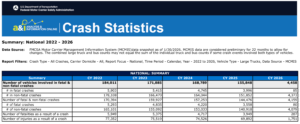
Using the total 2025 trucking statistics (3,558 fatal crashes and 3,949 fatalities), the impact of this ineligible driver population is calculated below:
*Note: This category includes non-domiciled drivers who remain eligible under the rule (H-2A, H-2B, E-2), as FMCSA found zero fatal crashes caused by these specific status holders in 2025.
While these percentages are statistically small, the FMCSA argues that because domestic-domiciled drivers are subject to rigorous history checks that foreign drivers previously bypassed, every crash in the ineligible category was theoretically preventable through proper vetting.
III. English Language Proficiency (ELP) Enforcement
Effective June 25, 2025, the FMCSA reinstated strict enforcement of 49 CFR § 391.11(b)(2). On February 4, 2026, a federal funding bill signed into law officially codified ELP non-compliance as an “out-of-service” (OOS) condition.
Every non-domiciled CDL driver must demonstrate the ability to read and speak English well enough to converse with the public, understand traffic signs, and respond to official inquiries. Inspectors utilize a two-step roadside assessment (Driver Interview and Highway Traffic Sign Recognition) during which the use of translation apps or aids is strictly prohibited.
IV. Supply Chain and Insurance Implications
A. Gradual Workforce Attrition
The FMCSA estimates that approximately 194,000 of the roughly 200,000 active non-domiciled CDL holders (97%) will be unable to meet the new criteria. However, because many properly issued licenses have 5-year expiration terms, the industry is expected to see a gradual “trickle” of attrition—approximately 40,000 drivers exiting per year through 2031—as current credentials expire.
B. Private Sector Insurance Reaction
Commercial insurance carriers have reacted preemptively to the non-domiciled CDL driver crackdown. Many policies now explicitly exclude coverage for accidents involving “improperly licensed” drivers. Fleets are being advised to conduct immediate audits of driver visa classes and CDL expiration dates to ensure they remain fully eligible under the new rule to maintain coverage.
V. Compliance Roadmap for Motor Carriers
-
Credential Audit: Immediately verify that every non-citizen driver holds a CDL issued under a qualifying visa category (H-2A, H-2B, or E-2).
-
Documentation Management: Secure copies of unexpired foreign passports and Form I-94 records with clear “Admit Until” dates.
-
ELP Readiness: Conduct internal assessments of English proficiency to prepare drivers for roadside OOS scrutiny.
-
Transition Strategy: Prepare for a steady reduction in capacity as ineligible non-domiciled licenses reach expiration over the next year and a half.
| Visa Status (Final Rule) | CDL/CLP Eligibility | Required Proof |
| H-2A, H-2B, E-2 |
ELIGIBLE |
Passport + I-94; Annual in-person renewal |
| DACA, TPS, Refugee, Asylee |
INELIGIBLE |
Must exit industry upon current CDL expiration |
| Humanitarian Parole |
INELIGIBLE |
EAD cards no longer accepted as proof |
Frequently Asked Questions (FAQ)
Who is an eligible non-domiciled CDL driver under the 2026 rule?
Under the FMCSA Final Rule effective March 16, 2026, an individual is eligible to be a non-domiciled CDL driver only if they possess an unexpired foreign passport and an I-94 arrival record documenting H-2A, H-2B, or E-2 nonimmigrant status.
Can a DACA recipient work as a non-domiciled CDL driver?
No. The 2026 Final Rule explicitly excludes DACA recipients, refugees, and TPS holders from obtaining or renewing non-domiciled commercial credentials. These individuals must transition out of CDL-required roles when their current licenses expire.
What are the English proficiency requirements for a non-domiciled CDL driver?
Every non-domiciled CDL driver must be able to read and speak English sufficiently to converse with the public, understand highway signs, and respond to official inquiries. Failure to meet this standard during a roadside inspection results in an immediate Out-of-Service order.
What are the 2025 safety statistics for the non-domiciled CDL driver population?
In 2025, ineligible non-domiciled drivers were responsible for 17 fatal truck crashes and 30 deaths. This represents approximately 0.48% of total fatal truck crashes (3,558) and 0.76% of total fatalities (3,949) for the year.