

Cogo’s Matrix of Geico and Progressive Insurance Trucking Auto Liability Rating Factors
Due to Cogo’s previous article, “Commercial Trucking Insurance Rates in Ohio, Texas, Pennsylvania and Illinois: What Really Drives Long-Haul Trucking Premiums?” being very popular, and questions and requests pouring in, we are continuing that subject here, and decided to make a simple to follow matrix of different rating factors.
There is no public Progressive or GEICO document saying that 20 percent of a trucking premium comes from the driver record or 10 percent comes from the motor carrier’s safety history. Insurance rating does not work that neatly. Carriers combine base rates, classifications, territories, limits, driver variables, discounts, surcharges, underwriting tiers, telematics and proprietary rating models. Still, trucking companies need a practical way to understand which factors matter most.
Cogo Insurance therefore developed the following 100 point rating influence model for a typical Class 8 for-hire interstate trucking account operating more than 500 miles from its base.
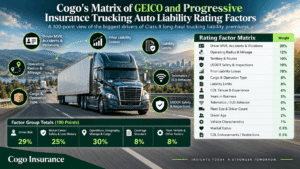
The percentages represent Cogo Insurance’s estimate of the relative importance of each factor to primary auto liability pricing, based on the Progressive and GEICO materials reviewed, state commercial auto rating information, and how the factors interact in a long-haul trucking risk.
They are not Progressive or GEICO filed percentage weights – that’s a trade secret. But we can approximate their weights based on open sources.
| Rating Factor | Cogo Estimated Weight | Relative Influence | Progressive Evidence | GEICO Evidence | Can It Become an Underwriting Deal Breaker? |
|---|---|---|---|---|---|
| Driver MVR, accidents and violations | 20% | Very High | Confirmed | Confirmed | Yes |
| Operating radius, annual mileage and long-haul exposure | 12% | Very High | Confirmed | Confirmed | Sometimes |
| Operating territory, routes and geographic exposure | 10% | Very High | Confirmed | Confirmed | Sometimes |
| USDOT safety, inspections and compliance history | 10% | Very High | Confirmed | Confirmed | Yes |
| Prior auto liability losses and claims history | 10% | Very High | Confirmed | Confirmed | Yes |
| Cargo and type of trucking operation | 8% | High | Confirmed | Confirmed | Yes |
| Liability limits and coverage structure | 8% | High | Confirmed | Confirmed | No, but directly affects premium |
| CDL tenure and relevant commercial driving experience | 6% | High | CDL and length held are explicitly collected | CDL related pricing confirmed in Ohio | Yes for inexperienced drivers in some programs |
| Years in business and motor carrier operating history | 5% | Medium to High | Underwriting relevance | Confirmed | Yes for some new ventures |
| Telematics and ELD driving behavior | 4% | Medium to High | Smart Haul can change premium | DriveEasy Pro can change premium | Rarely by itself |
| Fleet size, driver count and driver assignment | 3% | Medium | Confirmed exposure variable | Confirmed | Sometimes |
| Driver age | 2% | Low to Medium overall, potentially higher for very young drivers | Current standalone factor not publicly established | Confirmed commercial truck pricing factor | Sometimes |
| Vehicle safety characteristics, age and condition | 1% | Low for liability when all vehicles are Class 8 tractors | Confirmed vehicle factor | Confirmed | Sometimes |
| Driver marital status | 0.5% | Low | Current use not publicly established | Confirmed commercial truck pricing factor | No |
| CDL endorsements and restrictions by themselves | 0.5% | Low directly, potentially high indirectly | No standalone factor found | No standalone factor found | Yes if license does not permit the actual operation |
| TOTAL | 100% |
How to Read the Matrix
The weight is not the percentage by which your premium will increase or decrease.
For example, the 20 percent assigned to driver MVR does not mean that one speeding ticket raises a $20,000 premium by $4,000.
It means Cogo Insurance considers the driver’s accident and violation history to represent roughly 20 percent of the overall pricing influence when comparing otherwise similar Class 8 OTR trucking risks.
The actual effect can be much larger.
A serious violation might cause a carrier to decline the driver or the entire account. In that situation, the factor effectively becomes more important than its 20 percent normal weight.
The same principle applies to catastrophic losses, hazardous cargo, unacceptable inspection history or a very inexperienced CDL driver.
1. Driver MVR, Accidents and Violations: 20%
For most small and midsize trucking companies, Cogo Insurance considers the CDL driver’s record the single most influential driver-specific variable.
Progressive says commercial truck driving history has an unusually large effect on insurance cost. It warns that even a relatively minor speeding violation can materially increase trucking insurance premiums.
The insurer generally reviews approximately three years of commercial driver history, including accidents and violations.
GEICO likewise treats driver history as a commercial truck pricing factor.
This category includes:
- At-fault accidents
- Other reportable accidents
- Speeding violations
- Reckless driving
- Following too closely
- Improper lane changes
- Failure to obey traffic controls
- License suspensions
- DUI or DWI
- Other serious or major violations
- Number of events
- Severity of events
- Recency of events
Not every violation receives the same treatment.
A driver with one minor ticket nearly three years ago is not equivalent to a driver with two recent speeding violations and an at-fault crash.
This is why Cogo Insurance assigns the driver record 20 of the 100 points.
2. Operating Radius, Mileage and Long-Haul Exposure: 12%
A Class 8 tractor operating within 100 miles presents a different exposure from a tractor running 500, 1,000 or more miles from its base.
Progressive specifically recognizes long-haul trucking involving semi tractors operating beyond 500 miles.
Texas commercial auto rating guidance likewise distinguishes heavier trucks operating beyond a 200 mile radius through zone rating.
Longer operations can create more:
- Miles driven
- Time behind the wheel
- Interstate exposure
- Unfamiliar roads
- Weather exposure
- Congested metropolitan exposure
- Night driving
- Fatigue exposure
For the long-haul segment examined by Cogo Insurance, we assign radius and mileage 12 percent of the overall rating influence.
3. Operating Territory and Routes: 10%
Garaging ZIP code does not tell the whole story for an OTR motor carrier.
A truck based in Ohio that routinely travels through Chicago, New York City, northern New Jersey and other congested areas presents a different geographic exposure from a truck using mostly lower-density Midwest routes.
Progressive and GEICO both identify location as a commercial auto rating consideration.
Cogo Insurance therefore looks at:
- Home terminal
- Garaging ZIP code
- States entered
- Major metropolitan areas entered
- Regular freight lanes
- Frequency of Northeast operations
- Frequency of major urban operations
- Interstate versus intrastate travel
For true OTR operations, we give geography and routes 10 percent.
4. USDOT Safety and Inspection History: 10%
The motor carrier’s safety history provides information that an MVR alone cannot.
Progressive specifically lists inspection history among its truck insurance pricing factors.
GEICO identifies both USDOT compliance and inspection history.
Cogo Insurance therefore considers:
- Roadside inspections
- Vehicle out-of-service violations
- Driver out-of-service violations
- Hours-of-service violations
- Maintenance violations
- Unsafe driving indicators
- Crash information
- Changes in safety performance
- Compliance patterns
We assign this category 10 percent.
A serious pattern can become an underwriting issue rather than merely a pricing issue.
5. Prior Liability Losses: 10%
A motor carrier’s loss runs tell the insurer what has actually happened.
Underwriters can evaluate:
- Number of claims
- Total incurred losses
- Paid losses
- Outstanding reserves
- Claim frequency
- Claim severity
- Bodily injury involvement
- Litigation
- At-fault versus not-at-fault accidents
- Loss trends over several policy years
A company with five small incidents may present a different problem from one company with a single severe bodily injury loss.
Cogo Insurance gives historical auto liability loss experience 10 percent of the model.
6. Cargo and Type of Trucking Operation: 8%
The commodity being hauled can change the severity of an accident.
A general freight dry van does not necessarily present the same liability exposure as:
- Hazmat
- Tanker operations
- Automobile hauling
- Heavy equipment
- Oversized loads
- Logging
- Sand and gravel
- Waste hauling
- Refrigerated products
- High-value freight
Cargo also interacts with federal financial responsibility requirements.
For many nonhazardous interstate for-hire property carriers operating vehicles of 10,001 pounds or more, the federal BIPD requirement is $750,000.
Certain hazardous materials require $1 million.
Specified higher-hazard materials require $5 million.
Cogo Insurance assigns cargo and trucking operation 8 percent.
For some specialized operations, this factor can become much more significant than 8 percent.
7. Liability Limits: 8%
Coverage limits directly change the amount the insurer has at risk.
A $1 million combined single limit does not carry the same expected severity as substantially lower limits.
For trucking, the liability limit is often driven not just by state law but by:
- FMCSA requirements
- Freight broker contracts
- Shipper contracts
- Customer requirements
- Lease agreements
Cogo Insurance assigns liability limits and liability coverage structure 8 percent.
8. CDL Tenure and Commercial Driving Experience: 6%
This category deserves far more attention than most discussions of trucking insurance give it.
Progressive asks whether the driver has a CDL and how long the driver has held that CDL.
Cogo Insurance recommends separating several experience variables:
- Original CDL issue date
- Years holding a CDL-A
- Years driving Class 8 tractors
- Years driving tractor-trailers
- Years of interstate OTR experience
- Years with the current motor carrier
These are not necessarily interchangeable.
A driver could have held a CDL for ten years but have only one year of Class 8 OTR experience.
Another driver could have spent ten consecutive years operating tractor-trailers over the road.
Public filings do not reveal a reliable Progressive or GEICO percentage multiplier for each experience bracket.
Cogo Insurance still assigns CDL and relevant commercial driving experience 6 percent because driver experience can materially affect both rating and eligibility.
9. Years in Business: 5%
New ventures often have less operating history for an insurer to evaluate.
An established motor carrier may have years of:
- Loss data
- Inspection history
- Driver management history
- Maintenance history
- Insurance continuity
- Regulatory compliance information
GEICO expressly identifies years in business as a commercial auto pricing consideration.
Cogo Insurance assigns operating history 5 percent.
For a brand-new authority, this factor can have greater practical influence than the normal 5 percent weight suggests.
10. Telematics and ELD Behavior: 4%
Traditional insurance pricing relies heavily on events that have already happened, such as crashes and traffic citations.
Telematics lets carriers measure driving behavior before it generates a claim.
Progressive Smart Haul can use ELD data to adjust trucking premiums. Progressive states that driving data can increase or decrease renewal premiums.
GEICO DriveEasy Pro publicly identifies behavior such as:
- Hard braking
- Rapid acceleration
- Sharp turns
- Distance driven
- Speed consistency
- Late-night driving
- Total driving time
- Route consistency
Cogo Insurance assigns telematics 4 percent in the typical model.
For a carrier participating in a telematics-based rating program, its actual influence can become substantially greater.
11. Fleet Size and Driver Count: 3%
Progressive identifies the number of trucks and drivers as liability pricing variables.
GEICO also considers vehicle and employee exposure.
Cogo Insurance gives this category 3 percent because fleet size alone usually does not determine whether an account is good or bad.
The characteristics of the fleet matter more.
Ten tractors with ten experienced clean drivers can represent a very different risk from ten tractors supported by a constantly changing roster of inexperienced drivers.
12. Driver Age: 2%
GEICO explicitly identifies driver age as a commercial truck insurance pricing variable.
For Progressive, we found driver date of birth in commercial application data but did not find sufficient public evidence to state that a separate current Class 8 driver-age multiplier applies in Ohio, Texas, Pennsylvania or Illinois.
For the overall model, Cogo Insurance assigns age 2 percent.
That should not be interpreted to mean age is always minor.
A very young CDL driver can present a much larger underwriting issue than the 2 percent figure suggests.
The 2 percent represents its average influence across an ordinary pool of otherwise acceptable commercial drivers.
13. Vehicle Characteristics: 1%
Since this analysis assumes a Class 8 tractor, much of the vehicle classification is already fixed.
Progressive and GEICO both recognize vehicle type and characteristics as pricing factors.
For liability, however, the value of the tractor generally matters much less than it does for physical damage.
Safety equipment and vehicle condition may still influence the risk.
Cogo Insurance therefore assigns vehicle characteristics only 1 percent within this Class 8 primary liability model.
If this analysis included collision and comprehensive coverage, the vehicle’s age and value would receive much more weight.
14. Marital Status: 0.5%
GEICO expressly lists marital status among its commercial truck pricing factors.
Cogo Insurance did not find sufficient current public evidence to say Progressive independently rates marital status for Class 8 OTR trucking in the four states reviewed.
Even where marital status is used, we consider its influence small compared with MVR, mileage, operating territory, safety history and losses.
Cogo Insurance therefore assigns marital status 0.5 percent.
15. CDL Endorsements and Restrictions: 0.5%
Cogo Insurance found no reliable evidence that Progressive or GEICO automatically increases or decreases primary auto liability premium simply because a driver possesses:
- H, Hazmat
- N, Tank
- X, Tank plus Hazmat
- T, Doubles and Triples
The more significant question is what the driver actually operates and hauls.
An X endorsement by itself is not the same risk as actually operating a hazardous-material tanker.
The endorsement can therefore have a major indirect effect through cargo, vehicle type, required limits and underwriting classification.
Restrictions are similar.
A restriction that makes the driver improperly licensed for the assigned equipment may become an eligibility issue rather than a small premium surcharge.
For the endorsement or restriction itself, Cogo Insurance assigns only 0.5 percent.
The 100 Point View
For a typical Class 8 long-haul motor carrier, the model can be grouped into five broader categories:
| Risk Category | Approximate Weight |
|---|---|
| Driver risk | 29% |
| Motor carrier safety and loss history | 25% |
| Operations, mileage, territory and cargo | 30% |
| Coverage structure | 8% |
| Fleet, vehicle and other factors | 8% |
| Total | 100% |
This broader view may be even more useful for trucking companies.
Approximately 29 percent of the model relates directly to the driver.
Another 25 percent relates to the motor carrier’s historical safety and loss performance.
Approximately 30 percent comes from what the trucking company actually does, where it goes and how far it travels.
This helps explain why changing one variable rarely produces a simple percentage change in premium.
A trucking company with excellent drivers can still be expensive if it operates high-risk routes, has poor inspection history, hauls more hazardous commodities or has severe prior losses.
Likewise, an otherwise excellent company can receive unfavorable terms because one unacceptable driver changes how the insurer views the account.
For Cogo Insurance, the best way to approach trucking insurance is therefore not to search for one magic factor.
The goal is to improve the entire risk profile presented to the insurance company.
Summary
Cogo Insurance analyzed the factors that Progressive and GEICO consider when pricing commercial auto liability insurance for Class 8 long-haul trucking operations. The research focuses on Ohio and Texas, with Pennsylvania and Illinois used to provide added insight into rating approaches and publicly available filing information.
The resulting Cogo Matrix of GEICO and Progressive Insurance Trucking Auto Liability Rating Factors organizes the major insurance variables into a 100-point model showing their estimated relative influence on trucking auto liability premiums.
Cogo’s analysis indicates that the biggest pricing influences are not one single factor, but a combination of the CDL driver, motor carrier safety record, prior losses and the trucking operation itself.
The most influential factors include:
- Driver MVR, accidents and violations
- Operating radius and annual mileage
- Operating territory and freight lanes
- USDOT safety and inspection history
- Prior auto liability losses
- Cargo and type of trucking operation
- Liability limits
- CDL experience
- Years in business
- Telematics and ELD driving behavior
The analysis also looks closely at individual CDL driver characteristics.
GEICO publicly identifies driver age and marital status as commercial truck insurance pricing considerations. Progressive collects information about whether a driver has a CDL and how long the driver has held it. GEICO’s Ohio commercial auto program also identifies a CDL Experience Discount.
Cogo found no reliable public evidence that simply possessing CDL endorsements such as Hazmat, Tanker, Tank plus Hazmat, or Doubles and Triples automatically creates a separate Progressive or GEICO insurance surcharge or discount. The larger insurance impact comes from what the driver and trucking company actually do with those credentials.
Telematics is becoming another meaningful part of trucking insurance pricing. Progressive Smart Haul can use ELD data to influence trucking premiums, while GEICO DriveEasy Pro evaluates driving behaviors such as hard braking, rapid acceleration, sharp turns, mileage, late-night driving, total driving time and route consistency.
The matrix shows why a trucking company’s insurance premium cannot be explained by driver age, BASIC scores, loss history or any other single variable. Insurers price the driver, truck, motor carrier, cargo, territory and operating characteristics together.
For trucking companies, the practical lesson from Cogo Insurance’s research is that improving driver quality, safety performance, loss history and the quality of the insurance submission can have a much greater effect than focusing on smaller variables such as marital status or CDL endorsements alone.
Frequently Asked Questions
What are the biggest trucking auto liability rating factors?
For a typical Class 8 long-haul trucking operation, Cogo Insurance considers driver MVRs, accidents and violations among the strongest factors. Operating radius, mileage, territory, USDOT safety history, prior losses, cargo and liability limits are also major influences on premium.
How much of a trucking insurance rate depends on the driver?
Cogo’s 100-point model assigns approximately 29 percent of the overall rating influence to driver-related factors. This includes MVRs, accidents, violations, CDL experience, driver age, telematics, marital status and CDL characteristics.
This is a Cogo Insurance estimate of relative influence, not a Progressive or GEICO filed percentage.
What is the single biggest driver-related insurance factor?
The driver’s MVR, accidents and traffic violations are generally the most influential driver-specific factors. Cogo assigns this category 20 points out of the 100-point model.
A serious driving violation can have an even greater effect if it causes the insurer to surcharge, restrict or decline the driver.
Does driver age affect commercial truck insurance rates?
GEICO publicly identifies driver age as a commercial truck insurance pricing factor.
Progressive collects driver date-of-birth information, but Cogo Insurance did not find enough current public evidence to state that Progressive uses a separate Class 8 driver-age multiplier in Ohio, Texas, Pennsylvania or Illinois.
Does CDL experience affect trucking insurance?
Yes, CDL and commercial driving experience can matter.
Progressive specifically asks whether a driver has a CDL and how long the driver has held it.
Cogo recommends separating:
- Years holding a CDL-A
- Years driving Class 8 trucks
- Years operating tractor-trailers
- Years of OTR experience
- Years with the current motor carrier
These are different measures of experience and may not receive identical underwriting treatment.
How many years of CDL experience does Progressive require?
There is no single publicly disclosed Progressive rule that applies to every Class 8 trucking risk and state.
Progressive collects the length of time a driver has held a CDL, but the exact rating brackets and mathematical factors are not publicly available in the materials Cogo Insurance reviewed.
Experience may affect pricing, underwriting tier or eligibility depending on the operation.
Does GEICO offer a CDL discount?
GEICO’s Ohio commercial auto program publicly identifies a CDL Experience Discount.
GEICO describes eligibility in relation to the number of drivers holding commercial driver’s licenses. Cogo Insurance would not assume that the same discount or formula applies to Texas, Pennsylvania or Illinois without state-specific evidence.
Does marital status affect commercial truck insurance?
GEICO publicly identifies marital status as one of its commercial truck pricing considerations.
Cogo Insurance found no comparable current public evidence showing that Progressive uses marital status as a standalone Class 8 trucking rating factor in the four states reviewed.
Cogo considers marital status a relatively small factor compared with MVRs, accidents, mileage, safety history, operating territory and prior losses.
Do CDL endorsements lower truck insurance premiums?
Cogo found no reliable evidence that Progressive or GEICO automatically gives a premium discount simply because a driver has additional CDL endorsements.
An H, N, X or T endorsement may become highly relevant when the driver actually performs an operation requiring that endorsement.
For example, hauling hazardous materials in a tanker can materially change insurance exposure. Simply possessing an X endorsement while hauling ordinary dry freight is not the same risk.
Does a Hazmat endorsement increase commercial truck insurance?
The endorsement itself does not appear to be the primary issue.
Actually hauling hazardous materials can substantially affect insurance cost, underwriting appetite and required liability limits. Certain hazardous-material operations are subject to federal financial responsibility requirements of $1 million or $5 million rather than the $750,000 minimum applicable to many ordinary interstate property carriers.
Does operating more than 500 miles increase trucking insurance?
Generally, yes.
Progressive recognizes a long-haul or super-regional trucking segment involving semi truck tractors operating more than 500 miles from their base.
Long-haul operations can create more mileage, driving time, interstate exposure, urban traffic exposure, nighttime driving and unfamiliar road exposure.
Does the state where the trucking company is based determine the insurance rate?
It matters, but the garaging state and ZIP code are only part of the picture.
For an OTR trucking company, insurers can also consider where the trucks actually travel.
A truck garaged in Ohio but routinely operating through Chicago, northern New Jersey, New York City and other high-traffic areas can present a different exposure from another Ohio truck operating mostly in less congested Midwest markets.
Do trucking routes affect insurance premiums?
Yes.
Operating territory and routes can affect loss frequency and severity. Insurers may consider metropolitan congestion, states traveled, regular freight lanes, mileage and the geographic distribution of the exposure.
Cogo assigns territory and operating routes 10 points in its 100-point model.
Do BASIC scores affect trucking insurance?
USDOT safety and inspection history matter to trucking insurers.
A BASIC measurement should not automatically be translated into a particular percentage surcharge unless the carrier’s applicable rating methodology supports that conclusion.
Insurers may consider the broader picture, including roadside inspections, out-of-service violations, crashes, maintenance issues and driver-related compliance history.
Do roadside inspections affect commercial truck insurance?
Yes. Progressive and GEICO both publicly identify inspection or safety history as relevant to truck insurance.
Repeated out-of-service violations, maintenance problems or driver compliance issues can influence how an insurer views the motor carrier.
How much does prior loss history affect trucking insurance?
Cogo assigns prior auto liability losses 10 points out of 100 in its model.
Insurers may look beyond total dollars paid. They can consider claim frequency, severity, bodily injury involvement, fault, litigation, open reserves and whether losses show a developing pattern.
Does cargo affect auto liability insurance or only cargo insurance?
Cargo can affect both.
The type of commodity being transported can change the severity and nature of the liability exposure.
General freight, automobiles, heavy equipment, tankers, hazardous materials and other specialized trucking operations can therefore receive very different underwriting treatment.
Does truck age affect primary auto liability insurance?
Truck characteristics can affect liability pricing, but Cogo considers them less influential than driver, safety, loss and operating factors when comparing similar Class 8 tractors.
Truck age and value have a much larger direct effect on physical damage insurance, since the insurer is protecting the value of the tractor itself.
Can telematics reduce commercial truck insurance rates?
Yes.
Progressive Smart Haul can use ELD data in trucking insurance pricing. Progressive states that eligible participants can receive initial savings and that subsequent driving information can affect renewal pricing.
GEICO DriveEasy Pro can also use driving information to influence commercial auto premiums.
What driving behaviors can GEICO monitor?
GEICO’s commercial telematics program publicly identifies factors including:
- Hard braking
- Rapid acceleration
- Sharp turning
- Distance driven
- Speed consistency
- Late-night driving
- Total driving time
- Route consistency
This allows insurers to distinguish between drivers who might have identical clean MVRs but very different real-world driving behavior.
Does nighttime driving increase trucking insurance?
GEICO DriveEasy Pro identifies late-night driving as part of its commercial driving score.
For long-haul trucking, nighttime driving can therefore become measurable insurance information rather than simply an underwriting assumption.
Are new trucking companies more expensive to insure?
They often can be.
A new venture has limited company-level loss, inspection, maintenance and operating history.
An experienced driver starting a new motor carrier may have an excellent personal driving record while the company itself still has little history for the insurer to evaluate.
Is trucking insurance based more on the driver or the trucking company?
Both.
Cogo’s model groups approximately:
- 29 percent around driver risk
- 25 percent around motor carrier safety and loss history
- 30 percent around operations, geography, mileage and cargo
- 8 percent around coverage structure
- 8 percent around fleet, vehicle and other factors
The percentages are Cogo Insurance’s estimates of relative influence rather than carrier-filed rating weights.
What can a trucking company do to lower commercial auto liability premiums?
The most useful areas generally include:
- Hire and retain drivers with clean MVRs.
- Screen drivers before adding them to the policy.
- Build documented Class 8 and OTR driving experience.
- Reduce preventable accidents.
- Improve inspection and out-of-service results.
- Maintain equipment properly.
- Use telematics and ELD data to document good driving behavior.
- Maintain continuous insurance.
- Provide accurate cargo, mileage and radius information.
- Give the broker complete loss runs and driver information well before renewal.
Cogo Insurance uses these factors when helping trucking companies understand how insurers may view their accounts and how to present the risk effectively to available markets.